
The subtle centers - the lata’ifs
BismiLlahi-r-Rahmâni-r-Rahîm
The naqshbandiya Sufi brotherhood is characterized by different practices that distinguish it from other ways, in particular the dhikr khafi, the inner invocation, according to the path of the latâïfs, the subtle centers that "dilate" the chest, according to the Koranic expression : "sharh sadr" (dilation of the chest).
Indeed, chapter 94 of the Qur'an supports the specific orientation of the naqshabandi: "Did we not expand your chest, did we not rid you of the burden on your back, did we not exalt your dhikr?
Here, the word dhikr can also indicate the meaning of remembrance, renown or invocation, so the mention of "the exaltation of dhikr" also alludes, according to one of the meanings, to the progressive elevation of the invocation of the heart. This progressive elevation of the invocation corresponds to a more and more refined subtlety of the consciousness according to a path studded with the "points of reflection" of this consciousness in the chest, in fact the place where the Presence, the Hadrat, is welcomed.
This teaching of seven subtle centers in the chest may seem similar to the seven chakras, the wheels of energy in the Tantric teachings of India. The two presentations are in different contexts and in both cases present only reflection centers in the chest whose source is beyond the bodies. The great teacher of this science is none other than Sayidina l khidr, who is identified in Hinduism with the thousand-year-old yogi Babaji.
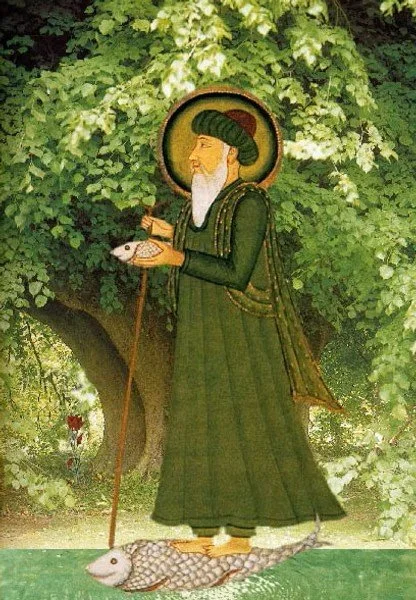
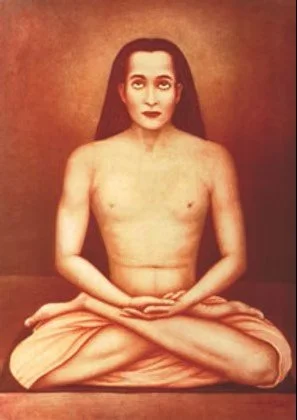
Khidr, assimilated in India to Mahavatar Babaji, the millenary yogi, and master of the afrâds, the "incomparable solitaries" of the divine wisdom.
Sayyidina -l khidr taught this science to the one who is called the "father of disciples" Khwaja Abdel Khaliq al Gudjwani, at the request of Khwaja Yucuf al Hamadani. It was from Khwaja Abdel Khaliq that the eponymous founder Khwaja Baha ud-din naqshaband received this teaching and instituted it as a regular practice in the brotherhood. There are 9 latâïfs of which seven are known and two are hidden (in any case not operational) because the last two will be transmitted (to the students) only at the time of Imam al-Mahdi, the path in the practice of dhikr according to the latâïfs corresponds to a path of progressive erasure of the veils on the heart which manifests lights of different colors. They also correspond to the "bezels of wisdom" (fuçus al hikam), i.e. the predispositions of the heart, like the prophets who crystallized the divine wisdom in their hearts and encased it in them like a precious stone set on a ring. Each of the latifa or subtle center is thus the receptacle of this wisdom or "Divine Presence" whose light takes the form and the corresponding prophetic light. Each time the aspirant progresses through this path through the subtle centers of his chest he relives at his level the spiritual heritage transmitted by these prophets.
He participates according to his level of consciousness in the assumption of the human consciousness whose arborescence developed in the soul of Adam, who became Noah, who became Abraham, who became Moses, who became Jesus, who became Mohammad. We are all reflections of this unique soul or we are this unique soul whose consciousness develops through the mirror of the history of the world whose history is the history of our soul. Thus, through this practice of Khafi dhikr through the latâïfs, we relive every day and every practice the unfolding of this consciousness through the maqam, the spiritual stations of all the prophets from which it is possible to inherit according to the hadith: "al - 'ulema wârithin al-anbiya'" (the authentic spiritual teachers are the heirs of the prophets).
The steps of the practice
It is traditionally considered that there is a ritual preparation for this practice according to the following rules :
The permission received from a sheikh ;
The state of ritual purity obtained by ablutions ;
The performance of a prayer of 2 rak'ah ;
The orientation with the face turned towards the Qiblah (Mecca) ;
The position of meditation ;
The request for forgiveness for all his sins ;
Reciting al-fatiha once and al-ikhlas (3 times) ;
We close the eyes, and stick the tongue against the palate towards the throat (kechari mudra, which stimulates the pituitary) ;
The spiritual act called rabitat al mawt, (the attachment to the tomb) which is a meditation on death we see ourselves dead, washed, wrapped in the shroud, the funeral prayer made on us then carried to the tomb and buried. With the loved ones gone, we are left alone ;
rabitat a-Sheikh, the heart connection with the Sheikh, the disciple holds his heart in front of the heart of his master, and keeps the whole image of the latter in his consciousness, concentrating all the corporal senses by withdrawing them from any other occupation and any suggestion, orienting himself with all the faculties of perception towards God Then one says: "You are my goal and Your satisfaction is what I ask";
The invocation is done with the name of Allah that one engraves (naqsh) in his heart following a path according to the express indications of the Sheikh who will lead the disciple giving him the breath and the authorization to progress at each step
Naqshbandi Lata’ifs
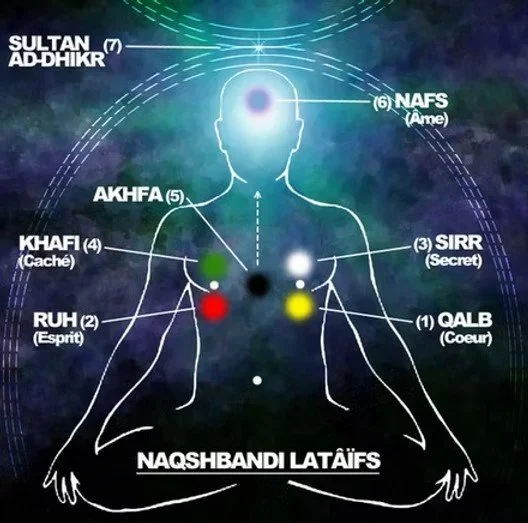
1 - The first subtle center, latifa is called QALB, the heart located two finger widths below the left breast, towards the heart. Its "light" is "yellow". The corresponding maqam (station) is that of Adam (sense of the earth) its quality is repentance (maqamat at- tâïbûn).
2 - the second subtle center, latifa is called RUH, two finger widths under the right breast, towards the chest. Its "light" is red. The corresponding maqam is that of Noah (memory of water), the quality is perseverance which allows to survive the waves of passion.
3 - The third spiritual center, latifa is SIRR, two finger widths above the left breast. Her "light" is "white" - the corresponding maqam is the joint one of Abraham and Moses, (the two masters of fire according to the Quran), the spiritual authority, the strength to stand up for the truth.
4 - The fourth subtle center, latifa is KHAFI is symbolically placed two fingers above the right breast, towards the chest. Its "light" is green - the corresponding maqam is that of Issa (Jesus) - Master of breath and life (maqam as-sâihûn, according to the Koran, Sura 9).
5 - the fifth latifa is AKHFA located symbolically in the middle of the chest, its "light" is "black" (the mystery of the unmanifested) - the corresponding maqam is Muhammad (Saw).
6 - the sixth latifa is symbolically located between the eyes, NAFS it corresponds to the maqam of the master (rabb) of the masters (the anbiyas) it is the place where one meets his soul according to the hadith (man‘ arafa nafssahu ‘arafa rabbahu).
7 - The seventh subtle center SULTAN AD-DIKR is symbolically located at the top of the skull - It corresponds to the maqam indicated in the Quran by : "al hafizun li hudud Allah" (chapter 9). It is the totality of the cells of the body which vibrate in this dhikr with the feeling that the whole of the creatures and things of the world, speak to each other in an interactive language where all is love and praise.
Practice of nafi‘-wa-l ithbath
This very important practice comes after the practice of the subtle centers, the latâïf, because it will install an internal movement of the spiritual energy. This ruh, this spirit, conveyed by the breath which is thus in a way distilled by this operation will circulate in all the body, purify the dark parts and illuminate the pure parts. The formula of the shahada begins with a negation "la ilâha" which corresponds to the path of fana extinction and then continues "illa llâh", al baqa billah, subsistence by God. Nevertheless, the method is precise although there are some variations according to countries such as Turkey or Pakistan. We start by putting the tongue at the back of the throat then we take a deep breath, we hold the breath and mentally we pronounce "LA" from the navel passing by al akhfa we go up to the center an nafs, from there we go down on the right shoulder by pronouncing "illah" (the energy naturally goes down on the centers on the right but we do not take care of it) from there we go to "hit" the center of the heart qalb with "illal lah". This center then radiates the energy of light that will purify the whole body.
This internal movement is repeated from 7 to 21 times while holding the breath, then we finish with the formula: "Mohammad rasûl Allah". All this is done in breath-holding and then released. There are modalities in apnea before the breath is taken again. This as well as the number of recitations in odd numbers is mentioned by our masters as "wukûf 'adadî". One can also practice a greater number of shahada during retention (as in India) but all this is done only under the guidance of the Sheikh or his representative who has practiced and whose experience is indispensable. The effects are very clear and very powerful because the inner circuit will then work by itself and invigorate the subtle centers and the whole body spontaneously without even soliciting the movement which leads to ecstatic states. Needless to say that the time of the khalwa is particularly indicated for these practices.
Mouraqaba
These are different methods of meditation from that on sins, on death, to that of unity in all things. This pedagogical practice comes after the dhikr in accordance with the Koranic injunction : « al-ladhina yadhkuru-na l- llah qiyyâma-n wa qu’udan wa ‘ala junûbihim wa yatafakkaru-na fi- khalqi samawati wa l-ardhi » (Those who invoke Allah standing, sitting, lying down and then meditate on the creation of the sky and the earth).
It leads people of realization to become capable of teaching or transmitting at all existential levels according to the spirit of "descending realization" highlighted by Sheikh Abdel wahid Yahya, Rene Guenon.