
Article 14 : Ibn Arabi - Function and the story of his conversion to the Great Way
BismiLlahi-r-Rahmâni-r-Rahîm
Shaykh al-akbar, Muhiyuddin Ibn arabi, is the seal of Muhammadan sainthood (Khatm al wilaya muhammdiyya). By this expression, we mean that the greatest of masters, Ibn arabi, possesses, through his oeuvre, the interpretation par excellence of the Muhammadan Law; Indeed, the Prophet Muhammad is the seal of legislative prophecy, Khatm al-anbiya wal mursalîn, representing "the final enunciation of divine Law" (in the sense of Dharma, which could be paraphrased as "eternal cosmic Law of divine origin"), which has enabled it to be "fixed" for the human cycle. Ibn Arabi, for his part, represents the inner, or essential, aspect that makes it possible to universalize the Shari'a of Islam throughout the present traditional domain. This universalizing operation will take place under the aegis of the Mahdi, a function that includes the Christ of the Second Coming according to the symbolism of the two Nûn evoked in our previous articles and the following hadith: Lâ Mahdi illa 'Isa, "No Mahdi except Jesus". The Mahdi, then, who, according to Michel Valsan (Sheikh Mustapha), "in correspondence with the symbolism of the end of the cycle, will exercise an apocalyptic magisterium of spiritual transposition and universalization, involving all sacred forces and applying to the entire traditional domain".
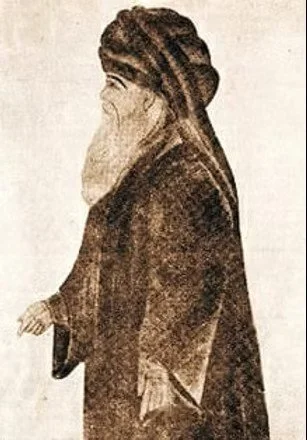
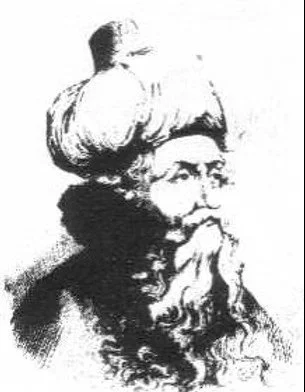
Sheikh al-Akbar, Muhyydin Ibn Arabi, is the greatest master of islamic esoterism. He inherits from the maqam of Seal of Muhammadan Sainthood. In this end of cycle, none will access the prophetic science for our time unless through adab towards the Light of Sheikh al Akbar
In the spiritual order of the end times, Shaykh al-akbar represents the "Divine Intermediary" between the Prophet Muhammad and Imam al-Mahdi. From a cyclical point of view, the existence of the Seal of Muhammadan Sainthood coincides with a decisive moment in the 13th century. This was the century of the disappearance of the exoteric Caliphate as a source of effective power, and of the institution of the great initiatory brotherhoods. Following the divine order to " Counsel my servants ", Ibn arabi formulated a readaptation of Islam in line with the prerogatives of the end times and its universal vocation beyond its historical framework. It's worth noting that the divine order to Ibn arabi to issue "counsels" not only establishes an eschatological investiture, but also makes him THE reference in matters of science and doctrine, for ultimately the science of Sheikh al-akbar is none other than the science of the Seal of the Messengers, SeyidinaMuhammad (sws) (On this subject, see the vision of the Prophet, recalled below, at the origin of one of Sheikh al-akbar's major works: Fûsus al-hikam).
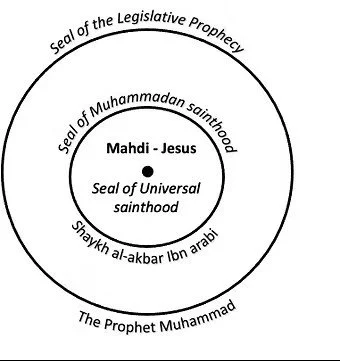
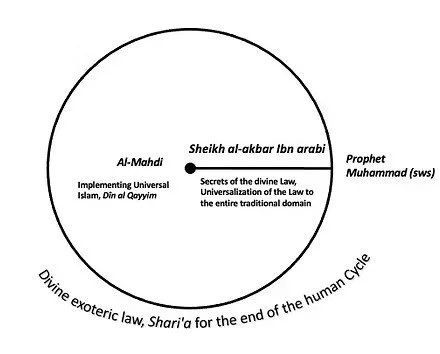
The doctrine of the 3 seals of Islamic esotericism, where the Shaykh al-akbar makes the "link" between the Prophet Muhammad (sws) and the Mahdi.
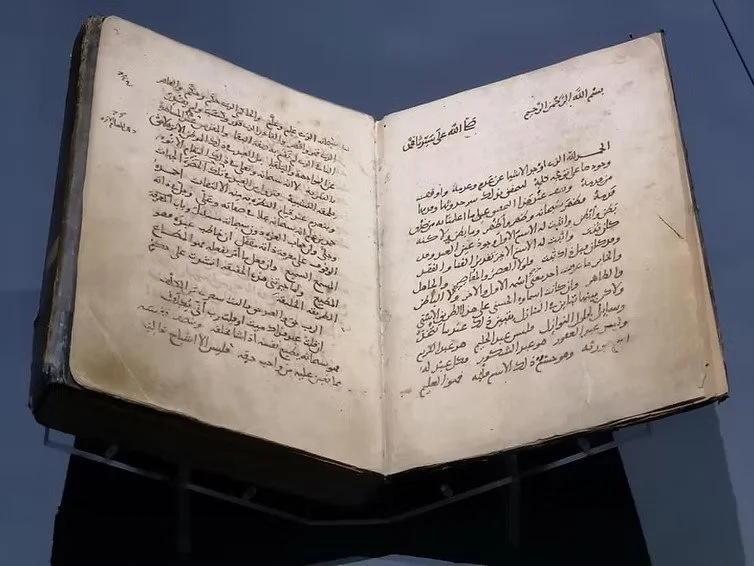
Sheikh al-akbar's function is reflected in the practical embracing, with the requisite adab, of his written works, in particular the two main ones of major eschatological interest: al-Futuhât al-makiyya (The Meccan Illuminations) and the Fusus al-hikâm (The Book of the Bezels of Wisdom).
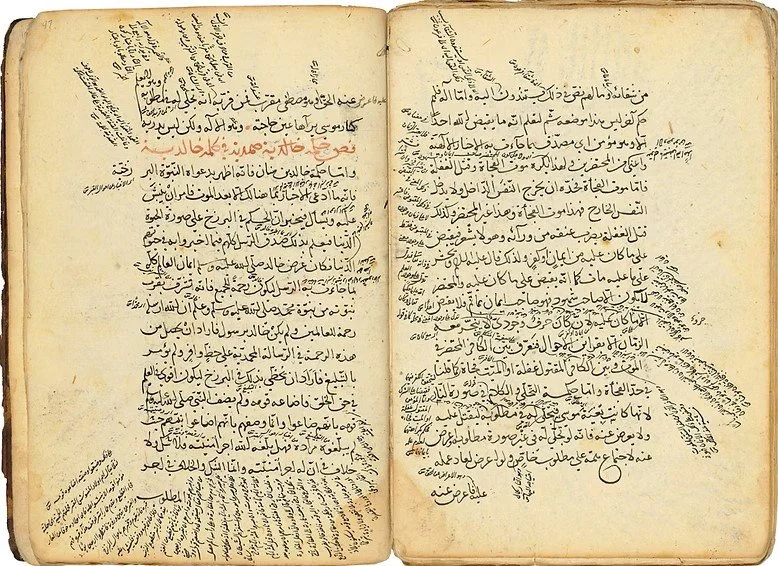
Ibn Arabi's handwritten edition of Futuhat al-makiyya, present in Istanbul, on the left, and an extract from fusus al-hikam on the right.
The Book of the Bezels of Wisdom
To illustrate Ibn arabi's function as the seal of Muhammadan sainthood, we offer another example with the Book of the Bezels of Wisdom (Fusus al-hikâm), whose apparent author is Ibn arabi but whose true source is the Prophet Muhammad (sws) as revealed by the auspicious dream at the beginning of the book: "Verily, I saw the Messenger of Allah (sws) during an auspicious dream I had during the last decade of Muharram in the year 627, in the compound of Damascus. He was holding a book in his hand. He said to me: "This is the Book of the Bezels of Wisdom (Fusus al-hikâm); take it and express it for the human beings, that they may profit from it!"" It should be noted, with care, that the Messenger of Allah (sws) asks to express the book for all men in a general way without exclusion and not in a way specific to the historical Muslim community; Added to this, in ibn arabi's era, the content of the book could only be limited to the geographical area of historical Islam due to the cyclical conditions of the moment willed by Divine Will. Therefore, as the Prophet's order concerns humanity as a whole, it is in our own era that the content of this blessed book should give its true meaning and provide the esoteric basis for a universal divine reconciliation in the traditional domain, at a cyclical moment when the different religions and traditional forms are confronted with each other, by globalization, and where both their antagonism and naive syncretism play the game of the Antichrist. Each of the verbs, or bezels of wisdom, expresses a fundamental aspect of Eternal Wisdom and a metaphysical doctrine that transcends the framework of the three monotheisms to which the prophetic verbs belong. All the founding truths of the traditional forms are synthesized in this book of prophetic origin, and it therefore serves as the basis for the "People of the Mahdi" to bring about Universal Divine Reconciliation and reunite "All the Good of the End of the Cycle" under the guidance of Imam al Mahdi.
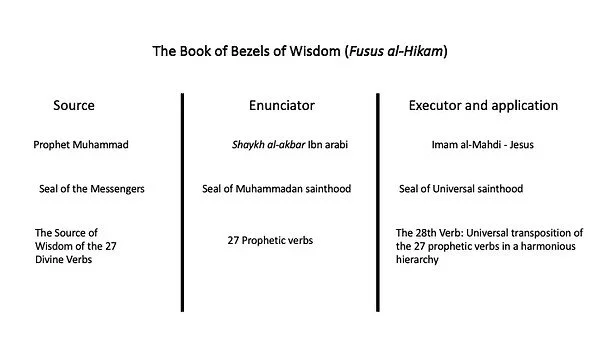
The seal of Muhammadan sainthood is the Mediator between our age and the Source of wisdom of the Seal of the Messengers, Seyyidina Muhammad.
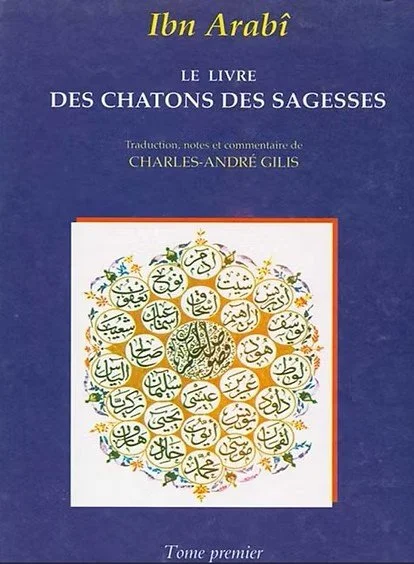
Fusus al-Hikam translated and commented in french, based on René Guénon's teachings, by Charles-André Gilis (Sidi Abderrazaq Yahya)
It goes without saying that Ibn arabi's function must be seen in a traditional context, where the modern world must be brought back to its rightful place in the hierarchy of being, and where the mind must be purified of its profane character. At a time when anti-traditional and even counter-traditional elements are omnipresent, it is essential to complement the function of Ibn arabi with the function of René Guénon, Sheikh Abdelwâhid Yahya, who purifies the mind of the "imprints" of the modern world. That's another subject we can't go into here.
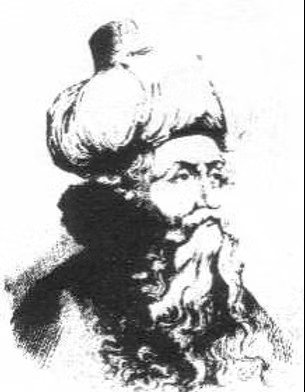
Sheikh al-akbar, Ibn Arabi and Sheikh Abdelwâhid Yahya, two major complementary functions under the Supreme Center, Diwan al-awliya, for the end of time
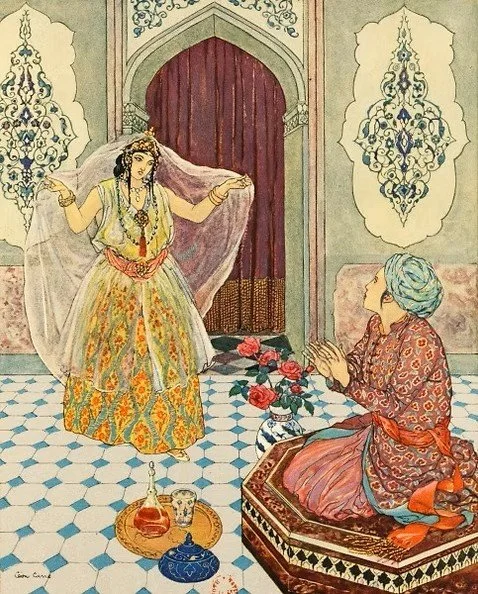
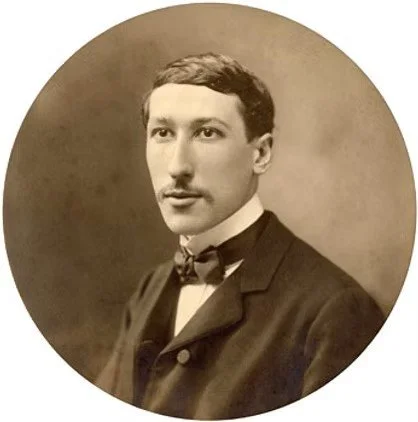
After sharing a few elements about Ibn arabi's function, we thought it would be useful to put into perspective the debut on the Great Way of the greatest of masters, in order to illustrate that despite a period of ignorance when we may externalize the negative possibilities present within us, divine grace can at any moment recover us and grant us His nearness.
We share here, his tale of sudden conversion to the Great Way and the quest for ultimate divine Reality.
Narration :
“That evening, as every evening, I met my friends in front of the house of one or other of them. At that time, my friends were all sons of princes or ministers. We were rich, carefree and doubtless most of us were unhappy. Conflicts between kingdoms did not concern us; neither did alliances between Muslims and Christians. We were young and making the most of our youth.
In those days, night was busier than day in Seville. We never went to bed before dawn. I would often be making my way home when the call to dawn prayers rang out from the muezzin. If I still had the strength, I would go into a mosque and after making the ritual ablutions, dry ablutions with a stone as I did not want to wet my face, and even less did I want to wet my hands and feet, I would join rows of the faithful. But my thoughts would bolt off in all directions like an unbroken horse. I would taste again the delights of the previous evening, the magnificent music of Andalusia, the languorous chords of the lute, the salacious dances with young women who soothed our burning gaze, the scents of amber and musk.
Half asleep, I awoke with a start when it was time to prostrate ourselves. I was no longer listening to the imam, hoping that he would soon finish. I asked myself why he had to recite the interminable al-Baqara or al-Imrân sura. Why could he not recite al-Infitar or al-Fajr? I usually made do with the brief verses of al-kawthar; then I left, exhausted and stupefied, to go to bed. I often did not get up again until after midday. My mother never complained, and would bring me crispy pancakes with honey.
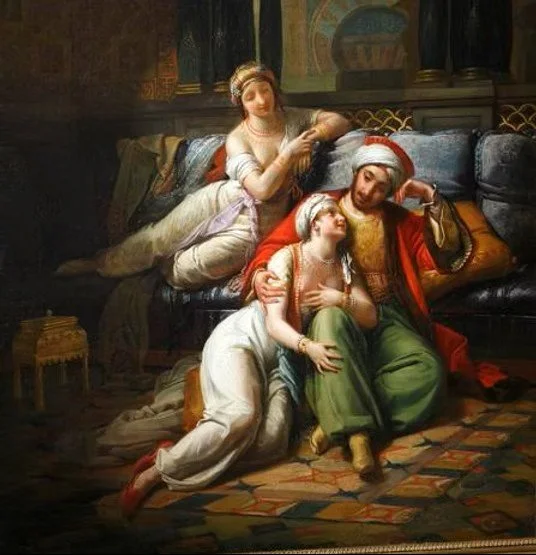
Ibn Arabi's life before entering the spiritual path: a mixture of pleasure and worldly refinement
My cousin ‘Abdelaziz, who had followed us from Murcia to Seville, was always ready to involve me in these nocturnal wanderings. Life seemed to be nothing but a ceaseless whirl of parties. Nevertheless, I sometimes felt that with all the wars going on around us, the fun might one day come to an end, Seville might be reduced to ashes, that enemy armies might march in, their soldiers spitting on our corpses.
When I spoke to him such things, Abdelaziz would say, “All the more reason to make the most of every fleeting moment!” His words did nothing to calm my innermost fears, on the contrary, they inflamed them. Of course, I was already following the teachings of certain masters, such as Abu Abdallah al-Khayyat, but their wisdom did not reach me. I learnt the Koran; I studied the stars and the heavens, mathematics and science. I was talented, perhaps too talented, and I enjoyed studying, but my studies never seemed to lead anywhere. What was the point of following this pathway? My route was already mapped out: I would be the same as my father, a minister to a Sultan. Inshallah, I would receive many honours and favours.
I think back on this time as the time of my great ignorance, my jâhiliyya.
That particular night began like all others. There were rose petals floating in the palace fountains, there were acrobats making a fragile human pyramid, a monkey-tamer forced his animal in its little gold waistcoat to imitate our actions. I grabbed a cup of wine that someone offered me, but the taste of it burned my throat, its bitterness made me cringe. It was like vinegar. All around me other people roared with laughter, already drunk. I had not yet drunk a mouthful, yet I felt overwhelmed with dizziness. I had to sit, and then to lie on a divan. A girl with blond hair and a peachy complexion stroked my forehead; I pushed her roughly away. She was no huriyya, no virgin awaiting true believers when they enter paradise, she was an evil she-devil. My friends’ faces were torture to listen to, and their empty words hurt my ears.
A prince came towards me, “What is wrong, Muhyuddin? You feel weak? You need some more to drink! Drink up!” He raised my chin with his right hand so that my lips once again touched the rim of the cup. All around me I could see nothing but shadows, dancing phantoms and gibbering skeletons. I trembled with cold, with a fever, my teeth chattered. Suddenly, I felt as if I were slipping away falling into a bottomless well. The noise stopped and I was floating in nothingness. And in a bright light a face appeared. It had such a gentle smile that I was immediately soothed. His eyes looked right into my soul, and I knew who it was, it was Sayidina ‘Isa who lived among men and who will return at the end of time! His voice broke the silence, “Muhyuddin, was it for this that you were created?” he asked, and then he disappeared.
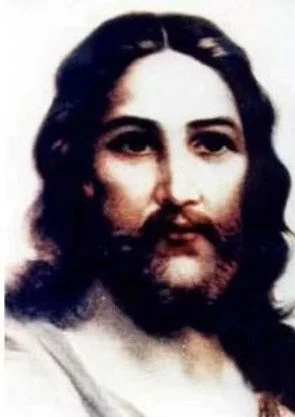
The appearance of Jesus, the seal of universal sainthood, to Ibn Arabi to awaken him from his ignorance is not unrelated to the special relationship that unites them through their respective eschatological functions
Was it a dream? The next day I awoke on the divan where I had fainted the night before. All my companions had disappeared. There was a horrible smell in the air. The water ine the fountains no longer sang, and the flowers had withered away.
I went to the bathhouse, alone, to cleanse my body and soul. The masseur scrubbed me vigorously and I saw layers of dirt come off my skin. I laid on the burning floor for a long while. Sayidina ‘Isa had provided answers to all my questions. Now I no longer worried about following in my father’s footsteps, about becoming an arrogant yet servile courtier. If God were to assign me such a role, then of course I would accept it, but never would I seek such a future.
As I came out, I saw a shepherd. I gave him my expensive clothes and put on his worn clothes. “Take me to the place where the dead are at rest!” I demanded. He took my hand and led me to the outskirts of Seville. There, amongst the stones that marked the final resting places of men who had once been living flesh and blood, and of whom nothing remained but mouldering bones, there I gave thanks to God for His gifts. I thanked Him for sending His messenger, Seyyedina ‘Isa, to me. I remained lost in meditation for the rest of the day. At dusk I saw the ruin of a tomb, with crumbling walls. I decided to retreat into it. For forty days and forty nights, I remained prostrate in the cemetery. My only company was stray animals that wandered, by a yellow bitch who shared the bread I was given by the few visitors to the dead.
My parents were worried and they sent my cousin, Abdelaziz, to look for me. When he found me, covered in hair and wearing nothing but the shepherd’s rags, he thought I had gone mad. He shook me hard, “Muhyyuddin! What has happened to you? All this time, all thses evenings, while we were drinking wine with those golden glints that warm the heart, while we were with the most beautiful women, you, you were here, feeling sorry for yourself, on the other side of the river.”
I took no notice of him, and continued with my dhikr, an invocation of Allah. Finally, he gave up. It was my mother who came to find me. Muna, my mother, spoke to me gently, “Come back, my son, come home to us!” I said a single word, Yahia, the name of her brother, she understood.
When my retreat was over, I entrusted all my belongings to my father, even those I inherited from my uncle, and decided that from then on I would own nothing. Nothing would belong to me, not even the djellaba on my back or the slippers on my feet.”
Ibn Arabi, extract from On the path of Ibn al-Arabi The revelations in Fez and Marrakesh
I met him at the Udays Mosque in Seville, when he was only
Ten or eleven years old: a sad and melancholy boy
Prone to intense stupors and blackouts.
A short time before meeting him, I had received an “inkling”
On the Path, though no one knew about it, and
When I saw him, I wanted to compare myself to him. I looked at him;
He looked back at me and smiled. I signalled to him,
And he signalled back. By Allah! I felt
Like a fraud before him. He said to me :
“Be diligent! Happy is he who knows for what purpose he has been
Created”. He accomplished the afternoon prayer with me,
Then, taking his shoes, he waved and left me.
I wanted to follow him, to find out where he lived,
But found no trace of him. No one could tell me anything about him.
I was inconsolable. I have never seen him since nor I have heard
Anyone speak of him until today.
There are masters who are young, others who are old.
Ibn al-arabi, the Sufis of Andalusia