
Article 10 : Dhikr Khafi (1/2)
BismiLlahi-r-Rahmâni-r-Rahîm
The question often asked of practitioners of the naqshbandi way is: what is its specificity compared to other brotherhoods? Recently, I even saw an interview where this question was asked to a student who claimed to be a naqshbandi, who answered : "it is the dhikr khafi", "the inner invocation" without being able to explain more, which he obviously did not know. Indeed, if one only develops invocation in an external way in festive meetings, one deprives oneself of the inner disposition necessary for the inner invocation. The practice of dhikr khafi begins with a "predisposition" which leads to a progressive "configuration" of the heart in order to "predispose" it to receive the specific graces of the inner breath. Of course, there are moments of celebration when the joy of praise demands that songs and invocations be manifested in an external way, but this is precisely a "celebration", a state of externalization of our feeling of praise.
This is not specific to the Naqshbandi way but common to all brotherhoods and Muslims. In this sense, Sheikh Nazim at one point allowed this form of externalization to develop because the disciples were no longer willing to receive the teaching of dhikr khafi. He explained this to me one day when I was surprised that he was no longer teaching others what I had received from him : the Lataif, the subtle centers, which support the circulation of the inner breath according to dhikr khafi. He said to me : "The students do not look for that anymore, they only talk about marriage, work, projects, external things...". Of course the former naqshbandi students have kept this practice but now we see that it is almost no longer transmitted and that the dhikr meetings are just moments of celebration between brothers, with a lot of publicity, film and over-communication. Of course, this shows at least a festive and peaceful image of Islam, which is already something, I admit. But this is not the inner way, the way of initiation... of excellence !
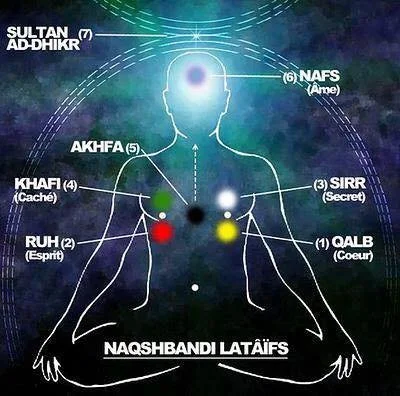
Sheikh Amanullah received the transmission of the lataif (subtle centers) from his Master Sheikh Nazim with permission to teach it
Insights on dhikr khafi to avoid gross forgerie
On a personal basis and in agreement with Sheikh Nazim, I have chosen to teach this dhikr khafi in the retreats or khalwa, because it is not a simple technique but also a transmission which must be accompanied by a follow-up with an "inner predisposition" of the whole Being. In order to give a simple indication and to open to one's taste, I can nevertheless give here some insights which will at least allow some to avoid falling into crude counterfeits. First of all, it is important to realize that this dhikr was taught by Sayyidina l-Khidr, the prophet who has been living for more than a thousand years and who is the link between the Primordial Tradition and the different traditions. This is confirmed by Sheikh Muhhyyidin.
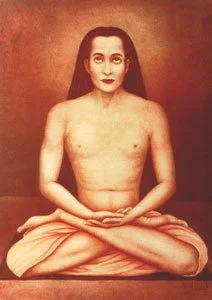
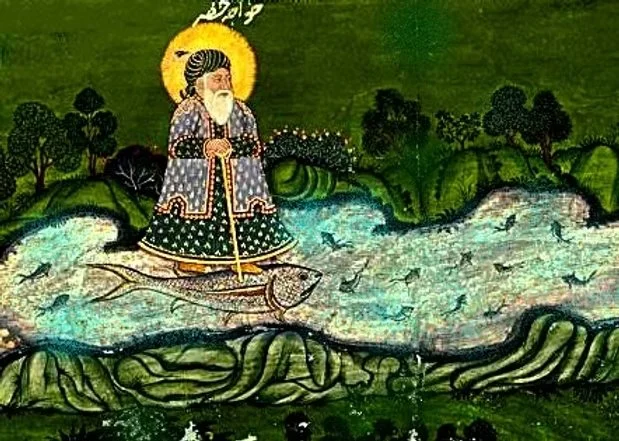
Representations of Khidr (the Verdoyant who "gives life where the earth has dried up") known in India as Mahavatar Babaji maharaj
It is in this sense that he intervenes for example with Sayyidina Musa (Moses) in the Quran in chapter 18. Now, the first Prophet living before the flood is Idris-Enoch and it is him who is represented by two complementary men (always according to the teaching of Sheikh Muhyyî d-din): Ylias (in his Jalal aspect) who works with the fire of the sky and Khidr (in his Jamal aspect) who works with the water. These two prophets are the teachers of the "sciences of Life" (of which breath is the essence).
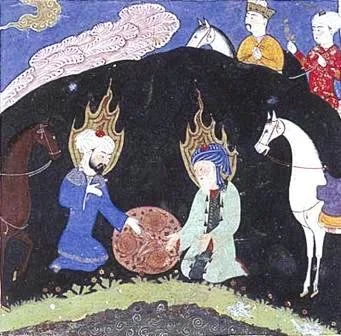
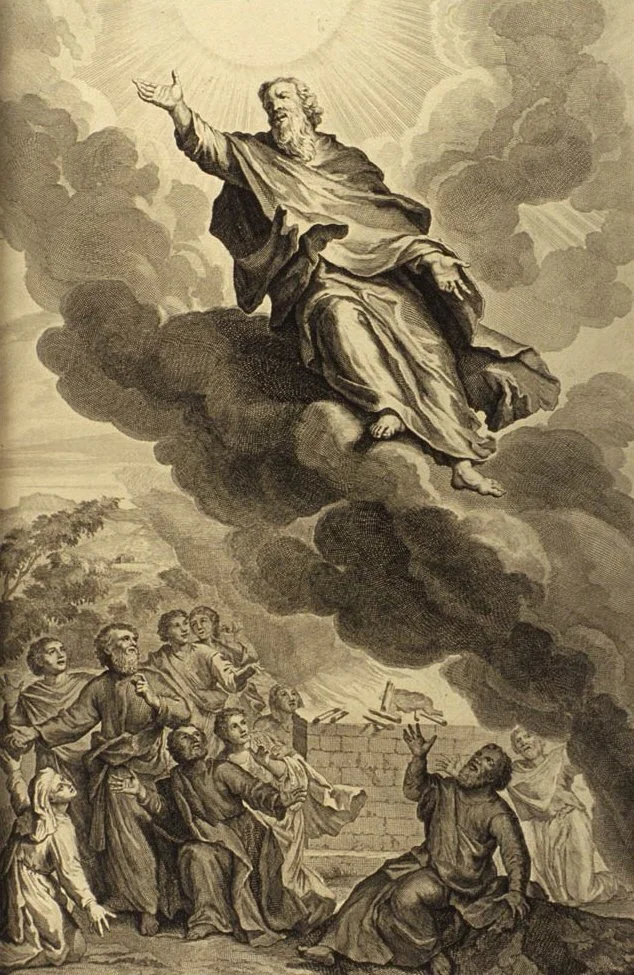
Idris-Enoch was raised in a "high place" (makânan 'aliyyan) according to the Qur'an is represented, after the Flood, by the Khidr and Elias who both drank from the Source of Life
Thus, sayyidina l-Khidr taught dhikr khafi, under water, to Sheikh 'Abd al Khâlik al-Ghudjwani (co-founder of the Naqshbandi way). This is an important point to be aware of the level at which one is situated. For it is in fact the science of the inner breath, one of the confirming effects of which is the ability to remain underwater for several hours until the breath becomes solely inner and then allows for contemplative ecstatic states. In this state not only does the breath stop but so does the heart. It is well known in the life of Sheikh Abdullah al-Fâiz Ad-Daghestani that he would stay for days or weeks in a state where his heart stopped. The first time his wife discovered him like this she rushed to Sheikh Sharafudin (his Sheikh) and said: "My husband is dead"... But Sheikh Sharafu-din laughed and said to him: "No! It is not what you think... he is in contemplation". When reading these lines, some people will say : this is a special case, this is an inaccessible way! Wrong! This is the true naqshbandi way and in all times there are graces that lead to this state. To this day, I have known other similar cases still alive in different countries of the world. Of course, there are different degrees of contemplation, but as a Chinese proverb says, "a thousand kilometers begin with one step". From the very first steps, there is an extraordinary joy in perceiving the inner breath as a manifestation of Ruh Ilahiyya (Divine Spirit). If there is a chain of transmission, it is so that the divine grace leads us on this path, provided that we properly prepare ourselves to receive it with the prerequisites. It is about : an attitude that leads the gaze inward (incompatible with noisy, flashy and narcissistic externalizations). It is about a predisposition to retreat into fasting and silence, and finally, it is about being in the companionship of those who have received the teaching and who accept to transmit it (to those who are mature). The teacher is there not to become an idol that one fears because of a function (often abusively created) but to help the student to free himself from the conditions of imprisonment created by his soul. He helps in tazkiyat an-nafs, that purification of the soul which is the first step. Then, he leads him to the "putting into orbit"
This is not a simple image but a very practical and real experience. Indeed, at the beginning the student is guided through an external breath circulation in relation to the subtle centers which are the places of opening and storage of the Light-Energy. One may remember how Khawja Baha ud-din Naqshband used to sweat in winter when he practiced dhikr khafi. This is a phenomenon well known to practitioners of the inner breath. It is a phase of the practice that gives an indication of the circulation of the internal Light-Energy. For it is indeed a movement of this Light-Energy circulating through the subtle centers in a continuous way until the golden embryo is born. The great Sheikh Azizan Ali Ramitani who lived to 130 years (which is significant of this technique of long life) was also taught by Sayyidina l-Khidr and he said that it was in "the secret of the heart" so those who claimed to be of the dhikr khafi (khafi meaning hidden) and who only sought to be known, were not really representative of this way .... khafi ! It is a subtle way (latif) as long as there is a sound, the breath is coarse. When the subtlety of the center of being becomes conscious, the breath starts to become very subtle until it stops. Then the breath enters the inner space. This is the wuqûf, the guarding of the heart. The beginning of the path. To talk about the technique further would be of no use because the technique without transmission and without companionship would only lead to deviations. I simply point out that it is exactly like putting into orbit with very precise steps of preparation. It is a science of internal alchemy in accordance with the Universal Law, the one that Idris-Enoch spoke about before the flood, the one that is at the heart of all true initiations in accordance with the eternal WAY, the one of which Sayyidina l-Khidr is the master and our teacher in this Golden Chain. May God help us to remain worthy of it instead of disfiguring its form by abusive externalizations.
See on the site under "practices" : "Subtle centers"